

Caregiver Monitor Q1 2025: Older adults seek new living arrangements

To gain insight into this, Beep for Help conducted a new study among 1,048 Dutch people between the ages of 50 and 65. This time, their concerns and preferences regarding housing are once again the focus. The results show that a large portion of this group is open to new forms of cohabitation, such as moving in with family, living in a residential community, or sharing their home with a student.

Anxious about what lies ahead
According to the Netherlands Institute for Social Research (SCP), many Dutch people feel uncertain about their future, partly due to societal changes such as population ageing, migration, and individualisation. The report Living Together in the Future highlights that these demographic developments may affect social cohesion and trust in society. Concerns about growing older also remain prevalent among the over-50s, especially women. The Informal Care Monitor shows that as many as two-thirds of women in their fifties worry about their future from time to time.

Family as a safety net
According to Statistics Netherlands (CBS), receiving informal care is strongly linked to age, gender, and distance. In 2022, for instance, no less than 31 percent of women aged 75 or older received informal care, compared to twelve percent of men. This difference is partly due to women living longer on average and being more likely to live alone. Proximity also plays a major role: almost half of the children of over-80s who live within 5 kilometres provide informal care. For greater distances, that percentage drops to 25 percent. The willingness to facilitate informal care by living together is growing. Beep for Help's Informal Care Monitor shows that many people over 50 are open to taking family into their homes. That willingness is particularly notable in Drenthe, where nearly half of the respondents say they are open to offering family a place to stay (possibly in the future).

Moving in with family
Women with parents over 80 provide informal care more often than men: 47 percent of women compared to 26 percent of men. This is shown by research from Statistics Netherlands (CBS). Women also spent more time on informal care: fourteen percent of women provided care for at least 8 hours a week, compared to just seven percent of men. Research by Beep for Help reveals that it is primarily women over 50 who would move in with family themselves. Strikingly, as many as 52 percent of higher-educated women in their fifties are considering moving in with family.

A house full of barriers
Only one in ten people aged 65 to 75 and a quarter of those aged 75 and over live in senior housing. This is shown by research from Woonz. In 2019, Statistics Netherlands reported that 39.2 percent of 55- to 65-year-olds consider their home unsuitable or not very suitable to grow old in. Climbing stairs plays a major role here: people over 55 who have step-free access to key rooms like the kitchen, toilet, bathroom, and bedroom are more likely to be positive about the suitability of their home (86 percent) than peers who do not (54 percent). Six years later, this challenge remains. Beep for Help's Informal Care Monitor shows that many people over 50 find their home less suitable. A quarter of over-50s with no children living at home consider their current house unsuitable—possibly because there is less reason to stay in a spacious, family-oriented property.
The housing market connects unexpected housemates
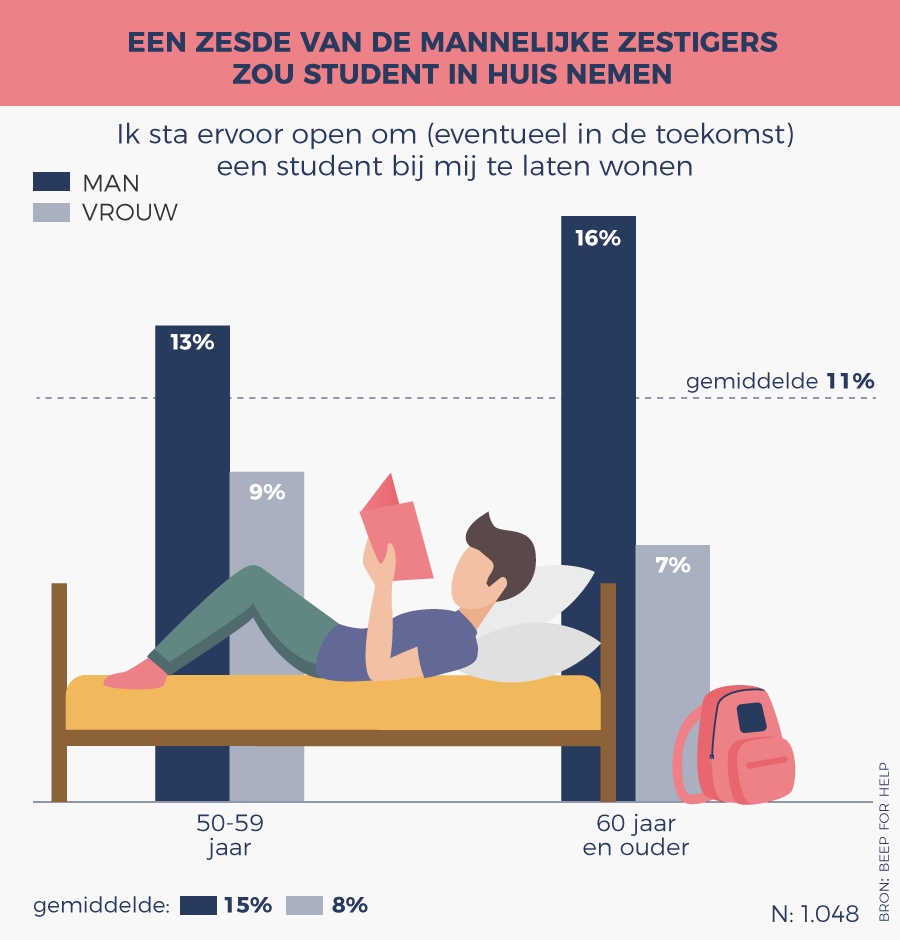
Research by Viisi Hypotheken shows that 61 percent of first-time buyers do not expect to be able to buy a home within three years. Despite slight improvements in sentiment, confidence remains low, partly due to high property prices and the limited availability of affordable housing. At the same time, many older people live in relatively spacious homes that do not always match their current needs. Beep for Help's Informal Care Monitor reveals that a large group of over-50s are open to sharing their home with a student. Interestingly, men in their sixties are particularly open to this: one in six of them is considering taking in a student.
A year of data
Curious about earlier editions of the Informal Care Monitor? Since early 2024, Beep for Help has been conducting quarterly surveys among Dutch people aged 50 and over on topics related to ageing—from financial concerns to digital skills and health. With this study on housing, we have come full circle, exactly one year later, back to the topic where it all began. View here an overview of all previous studies.
About Beep for Help
Beep for Help connects those in need of assistance with those who can provide it. Through its app and telephone line, the organization offers efficient and reliable support, aiming to relieve the burden on the elderly and their caregivers as much as possible. At the same time, Beep for Help is committed to addressing social issues such as an aging population and the growing pressure on caregivers.